by

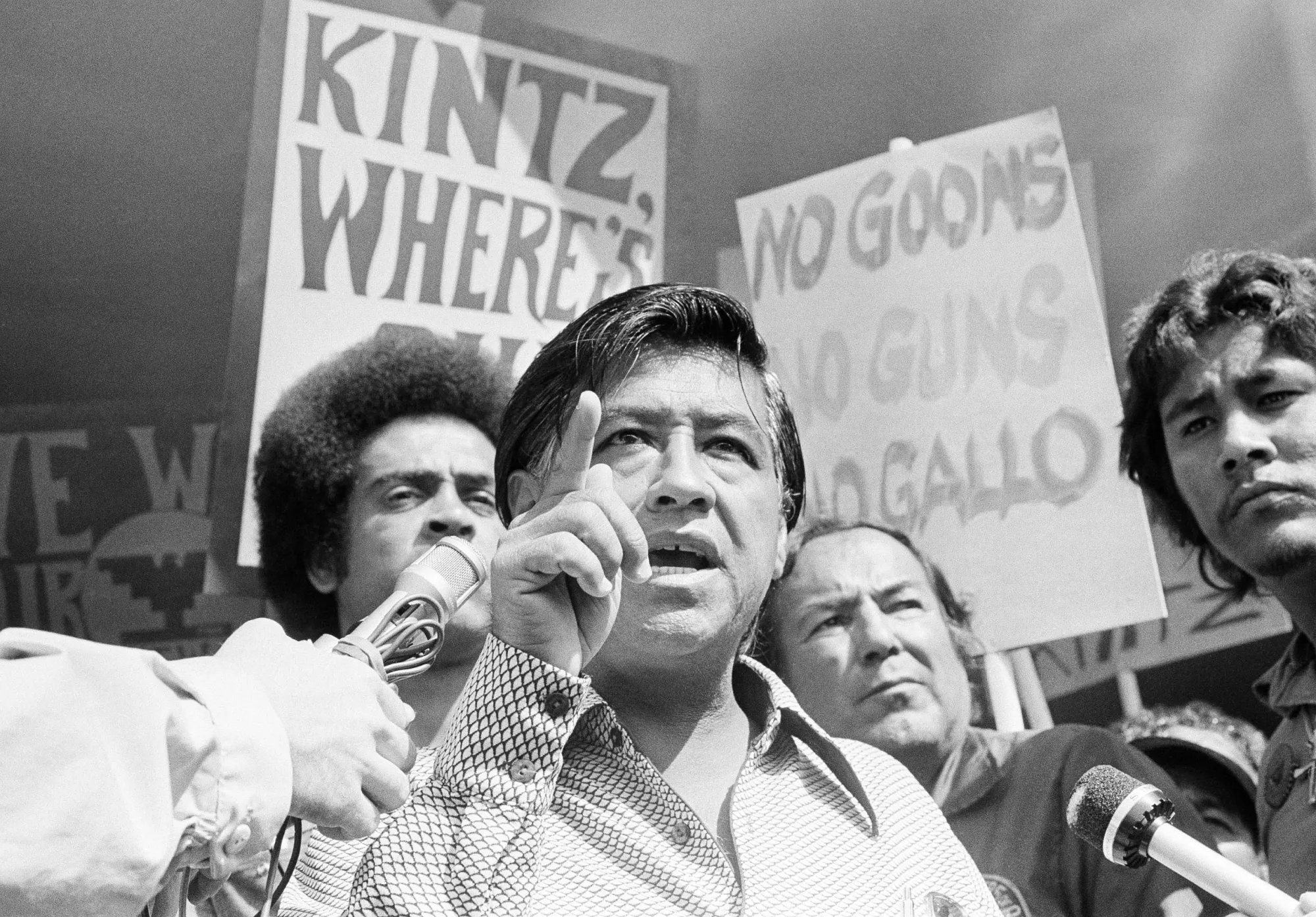
Cesar Chavez, head of the United Farm Workers Union, speaks at the headquarters for the state Agriculture Labor Relations Board on Sept. 16, 1975 in Sacramento, California. Chavez’s legacy has been tarnished in the wake of an investigation by the New York Times exposing years of sexual assault. (AP/File photo)
PHOENIX — When allegations arise of sexual abuse by prominent figures, survivors reach out at higher rates for support from local organizations.
Allegations against Cesar Chavez, a labor activist from Yuma, show a phenomenon Katlyn Monje, director of the Southern Arizona Center Against Sexual Assault, said is prevalent when celebrities or public figures are accused of sexual abuse.
“Seeing a lived experience that [survivors] can relate to in the news like this can really bring up a lot of emotions and memories, and even triggers about their own experiences,” Monje said. “So we do tend to see a bit of an increase in the calls to our crisis line.”
After months of social media feeds full of news about wealthy financier and convicted sex offender Jeffrey Epstein, Monje said, the allegations against Chavez come promptly before Sexual Assault Awareness Month in April. The allegations have directly affected local politics – on Wednesday, the Phoenix City Council will decide how to handle Chavez’s legacy in the city.
On March 18, the New York Times broke the allegations against Chavez. They were met with widespread outrage across the state and country, including calls to remove his name from streets and buildings. Chavez died in 1993.
Dolores Huerta, co-founder with Chavez of the National Farm Workers Association, came forward with allegations of sexual assault against Chavez on March 18 in the bombshell investigation. Other alleged victims of Chavez’s abuse came forward in a similar fashion.
“As a young mother in the 1960s, I experienced two separate sexual encounters with Cesar. The first time I was manipulated and pressured into having sex with him, and I didn’t feel I could say no because he was someone that I admired, my boss and the leader of the movement I had already devoted years of my life to,” Huerta said in a statement on March 18. “The second time I was forced, against my will, and in an environment where I felt trapped.”
When former Gov. Doug Ducey established April asArizona’s Sexual Assault Awareness Month, it came 18 years after the national awareness month was established.
In times like these, Monje said, SACASA works to make sure they are visible and available for the needs of the community they serve. Investigations like the Chavez case aren’t new to SACASA and other organizations.
“Sexual assault has very often kind of thrived in silence,” she said.
SACASA has a 24/7 Crisis Line – (520) 327-7273 or toll free at (800) 400-1001 – that Monje said has seen an increase in calls.
“If we look at statistics related to sexual assault, we know that nearly every minute somebody in the United States is sexually assaulted. We know that it is most often somebody known to the victim who causes them harm,” Monje said. “We also know that sexual assault is about power and control, of perpetrators using their positions of power to control others.”
In their most recent 2016 report, the Center for Disease Control and Prevention’s National Intimate Partner and Sexual Violence Survey found that 19.7% of Hispanic women and 3.2% of Hispanic men have been raped in their lifetime. It also found 34.8% of Hispanic women and 22.5% of Hispanic men have “experienced unwelcome sexual contact in their lifetime.”
Laura Palumbo, communications director at the National Sexual Violence Research Center, said that between the release of the Epstein files and the Chavez allegations, survivors of sexual violence are “handling so much right now.”
“We definitely hear that from our partners at the state and local level, that anytime there is a really high profile case, especially one that … really exemplifies how you know, even decades later, survivors, they feel ready to share their story, that it can lead to a lot of calls coming in and people seeking support,” she said.
Arizona Gov. Katie Hobbs, through an executive order, established the Governor’s Commission to Prevent Intimate Partner and Gender-Based Violence in 2019.
The commission’s most recent meeting discussed the 2025 statewide statistics on domestic violence, and included the Arizona Department of Economic Security’s Domestic Violence Services Fund Report. The report showed nearly 10,000 calls were made to domestic violence hotlines in Maricopa County during the fiscal 2025.
That’s almost 30 calls per day, or just over one call per hour.
Arizona also ranks at No. 8 in the nation for the number of calls made to the National Domestic Violence Hotline.
Chavez is a figure of civil rights activism in the state, with many connections to Arizona State University, such as the César E. Chávez Leadership Institute at Arizona State University.
The labor leader’s name is on countless buildings and memorials around Arizona, from ASU to Cesar Chavez High School in Laveen.
“We are aware and reviewing any action the university may take,” an ASU spokesperson said.
Alexia Tresemer, a student at ASU, said they weren’t surprised about the allegations against Chavez. Tresemer is treasurer of Devils in the Bedroom, an on-campus student organization that promotes sexual safety and provides sexual wellness education.
“I think at this point, it wasn’t surprising to hear of another prominent figure in the world doing something like this,” they said.
Tresemer said that when high-profile cases of sexual violence become well-known, survivors of such abuse can become inspired to share their stories. They said the communication and discourse around sexual violence and abuse can allow for people to come forward with their own experiences.
“It’s a problem that we have in American society of venerating these figures, and then when they aren’t perfect or they do heinous things, we not only break them down, but we break down any of the good that they’ve done,” Tresemer said.
Palumbo said that the news of allegations against Chavez perpetuates the imbalance between those in power and the pound who surround them who are at risk for abuse.
“All of us have the power to be a part of the movement to end sexual abuse, assault and harassment, and all of us can lend our voices and support that,” Palumbo said.
If you or someone you know has been sexually assaulted, immediate help is available. Call 911 for emergencies, or call the National Domestic Violence Hotline1-800-799-SAFE (7233) /Text “START” to 88788. Onlinechat helpis available as well. Here is a national directory of local providers by zip code.