
Surprised and not so surprised: King County Regional Homelessness Authority CEO addresses damning audit
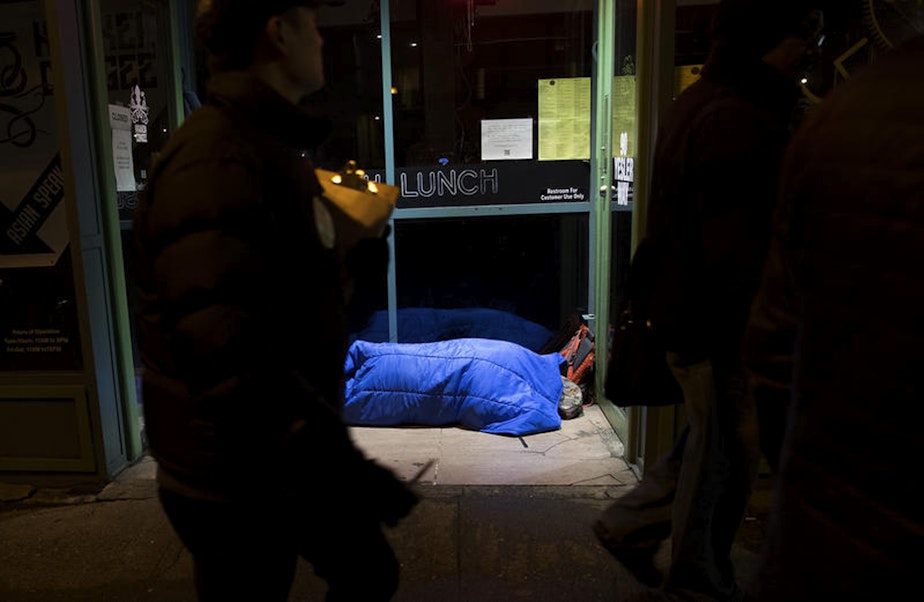
Volunteers count the number of people experiencing homelessness during the annual King County count on Jan. 25, 2018, in Seattle’s Pioneer Square. KUOW PHOTO/MEGAN FARMER
Despite a damning audit that revealed glaring financial mismanagement at the King County Regional Homelessness Authority, its CEO Kelly Kinnison still says the agency is making a difference and remains one of the region’s best tools to fight homelessness.
She also says she is not surprised by the audit.
“Frankly, I guess I live it every day, but I’m a little bit surprised at the surprise,” Kinnison told KUOW’s Soundside in an exclusive interview. “If you go back and read some of the news articles, did folks think this was all sailing right along and all the back end was looking good? Because, there were clear signs that things were not functioning properly in the early days.”
Kinnison spoke with KUOW’s Soundside about the results of the audit, KCRHA’s current response to it, and her experience taking over leadership of the agency. Listen to the full conversation below, or on your favorite podcast app.
The KCRHA handles the regional response to the homelessness crisis for King County and its 39 cities. A recent audit of its first four years of operation uncovered $13 million in overspending and unaccounted funds, as well as an operations deficit of $44.7 million.
The agency’s board opted to create a finance committee to handle corrective actions. Such plans are in the works.
Still, Seattle City Councilmember Maritza Rivera and King County Councilmember Rod Dembowski favor dissolving the agency. Seattle Mayor Katie Wilson isn’t even working with KCRHA on her own bold homelessness response and has expressed her own concerns.
Kinnison told Soundside that KCRHA has received reports from across the county about the difference they’ve made. So on one hand, she sees positive impacts. On the other hand, she is fully aware of the agencies current woes, and what led to them.
“I know there were tradeoffs and funding constraints [when KCRHA was founded] and folks had a lot of things on their plates, but no one stopped and said, ‘Whoa, we need to think about this,'” Kinnison said, adding that there were aspects of the operation that needed to be fixed at the start, such as providing proper administrative funding. This lack of administrative support to mitigate risks “ended up compounding over the years.”
King County Regional Homelessness Authority
The King County Regional Homelessness Authority has prompted concerns and skepticism ever since it was officially formed in 2019. Consultant Marc Dones played a major role in designing its structure and operations. The agency didn’t become operational until 2021 and Dones became its first CEO. Financial issues with KCRHA arose early on. The agency told the region’s leaders that addressing homelessness would be much more expensive than previously thought. Dones stepped down in 2023. His resignation letter cited both the accomplishments he was proud of, as well as burnout. “After five years I am tired. I believe the time has come for me to pass the baton,” he wrote.
Deputy CEO Helen Howell stepped up to temporarily lead the organization before L. Darrell Powell spent five months as another temp CEO. Powell was in the running for the permanent job, but withdrew his name from consideration, citing issues with the politics around the agency. His exit also came after internal drama and allegations he used offensive language.
Kinnison was appointed to the CEO job shortly after that in June 2024.
She described the KCRHA as a “small scrappy agency” that had to prioritize some aspects of the work, and deprioritize others, such as more rigorous financial management and documentation. She said that money was paid and the community received services, but the agency was not getting paid by its funders. That contributed to current financial problems.
Kinnison said she knew the agency had problems when she started the job. Her previous work was at the federal government level, so, she told Soundside, “I was very surprised at what I found at KCRHA.”
After a couple months on the job, working with the agency’s accounting team, she said it became clear something wasn’t right. There was a reliance on spreadsheets and journals, a system set up from the beginning that she said was not adequate. She also said she reported as much to officials at the city and county levels.
Today, however, she argues that KCRHA is not the same organization, compared to when she walked through the door in 2024. The agency has better staffing, more in-house expertise, and better data assets, she said. She has requested an accountant position at KCRHA and is waiting for approval. That, Kinnison argues, should help with traceability issues and help redesign the agency’s financial system. She also said KCRHA “desperately” needs more staffing hours.
Despite the audit, lack of faith from elected officials, and a rough start for KCRHA, Kinnison still argues that the agency is the best solution for the region’s homelessness crisis.
“I’ve been really needing to take accountability for a lot and that is hard. It’s also true I made choices. I had priorities,” she said.
“I’m a public servant, so I will do what is in the best interest of this work, but I think it is KCRHA and I think we’ve made really solid investments and we can do this. But I need to earn trust back from folks who really feel like things should have been fixed faster, or I should have made different decisions, or the agency should have.”